Distribution is a relationship business. Your customers choose their distributor based on reliability, availability, service quality, and how easy it is to do business with you. All of those factors depend on one thing: the accuracy and accessibility of your data. And in most distribution companies, the data that matters most lives in two separate systems that don’t talk to each other.
Your ERP manages inventory, orders, purchasing, and financials. Your CRM manages customer relationships, sales activities, and pipeline. Without integration, the gap between them is a constant source of friction — for your team and for your customers.
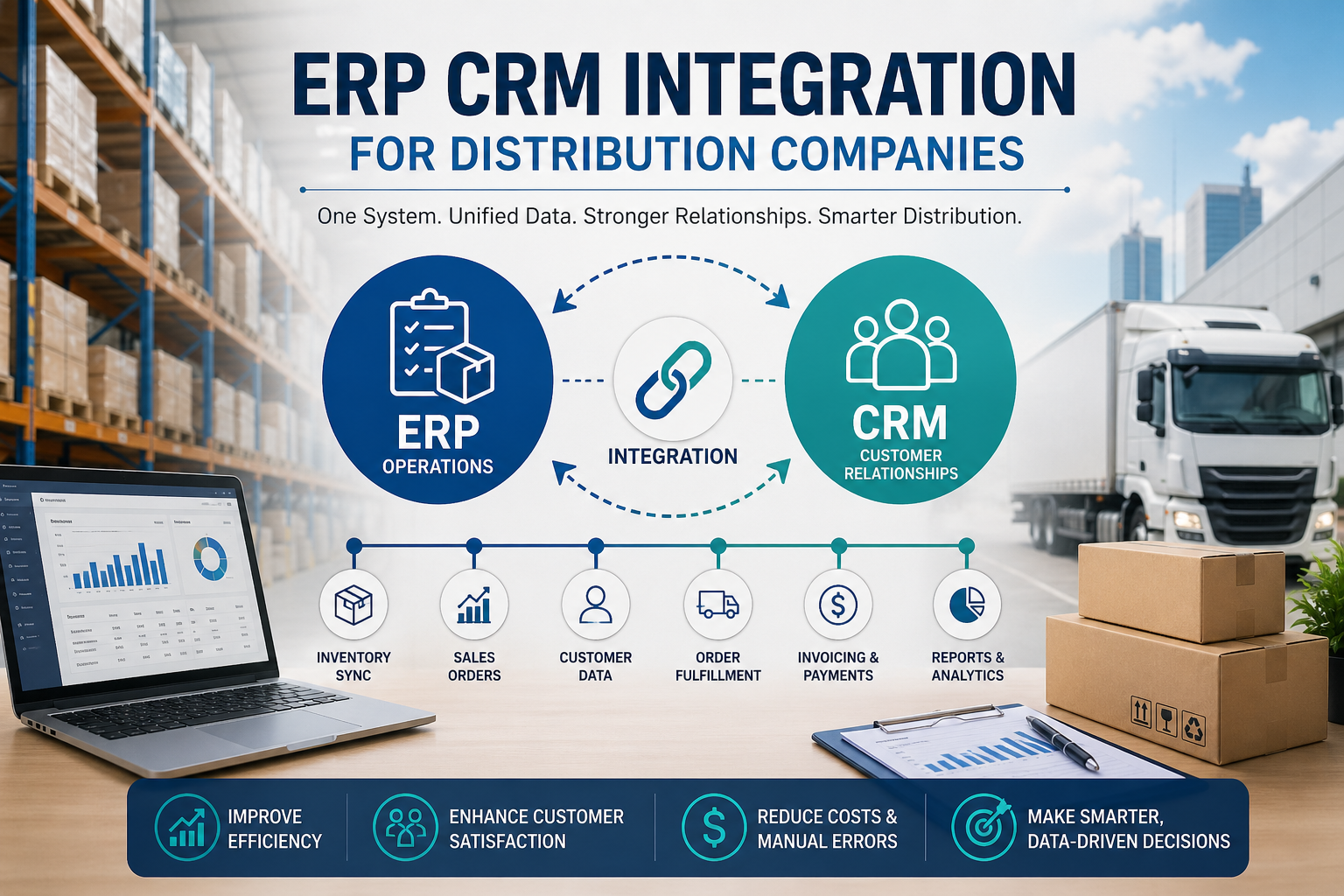
ERP CRM integration for distribution companies eliminates that friction by connecting both systems in real time, giving every team member access to the complete picture of each customer relationship.
The Distribution-Specific Case for ERP CRM Integration
Distribution businesses have specific operational characteristics that make ERP-CRM integration particularly valuable:
High Order Frequency
Distributors often process a high volume of orders from a relatively stable customer base. The difference between a great distributor and an average one is often speed — how quickly you can quote, confirm, and ship. Every second spent manually transferring data between your ERP and CRM is a second of delay that a competitor doesn’t have.
Inventory Is Everything
In distribution, your sales team’s ability to give customers accurate availability information is central to the value you provide. When CRM and ERP aren’t connected, sales reps quote availability based on last week’s inventory report — or worse, on instinct. Real-time inventory sync from your ERP into the CRM lets your team answer availability questions accurately and confidently, every time.
Account Management Depth
Distribution account managers carry large account portfolios and need to monitor many customers simultaneously for changes in buying behavior, at-risk patterns, and upsell opportunities. When purchase history from the ERP feeds into CRM contact records, account managers can see exactly what each customer has been buying, how frequently, and whether that pattern is changing — without logging into the ERP for every account review.
Pricing Complexity
Many distributors maintain complex, customer-specific pricing — negotiated rates, contract pricing, volume discounts, and special programs. When pricing from the ERP syncs to the CRM, your sales team quotes from the correct, approved pricing for each customer automatically — reducing errors, margin leakage, and the time spent looking up customer-specific rates.
Key Data Flows for Distribution ERP CRM Integration
A well-designed ERP CRM integration for distribution companies typically connects the following data between systems:
Customer Master Data
Customer records sync bidirectionally between ERP and CRM — so a new account created by sales in the CRM flows into the ERP as a new customer, and existing customer updates (addresses, billing contacts, payment terms) sync back to keep both systems current.
Order History and Line Items
Historical and current order data from the ERP surfaces inside CRM contact and company records. Account managers see a complete purchase history — products, quantities, pricing, order frequency — without leaving the CRM. This context is essential for effective account management and upsell conversations.
Quote-to-Order Automation
When a CRM deal or quote is won, an order is automatically created in the ERP — with all line items, pricing, and customer details populated automatically. This eliminates the most error-prone step in the distribution order process and accelerates your order-to-ship cycle.
Inventory Availability
Real-time or near-real-time inventory levels from the ERP feed into the CRM so sales reps can confirm availability without leaving the quoting workflow. For distributors where product availability is a primary competitive differentiator, this capability alone can justify the integration investment.
Invoice and Payment Status
Outstanding invoices, payment status, and credit holds from the ERP are visible in CRM account records. Account managers know when a customer has an overdue balance before they call to place a new order — allowing your team to handle the situation professionally rather than reactively.
Customer-Specific Pricing
Price lists and customer-specific contract pricing from the ERP sync to the CRM’s product library. Sales reps always quote from current, approved pricing — eliminating margin erosion from manual pricing lookup errors.
The Competitive Advantage of Connected Systems
Distribution is a market where margins are under constant pressure and customer loyalty depends on service quality. ERP CRM integration creates a measurable competitive advantage in several ways:
- Faster response times: Sales reps with real-time ERP data in their CRM can answer customer questions instantly — availability, pricing, order status — without putting customers on hold or escalating to operations.
- Better customer retention: Account managers who can see declining order frequency or shifting product mix in the CRM can reach out proactively before a customer defects to a competitor.
- Fewer order errors: Automated order creation from CRM deals eliminates the manual re-entry errors that lead to wrong items, wrong addresses, and wrong pricing — each of which damages customer trust.
- Shorter sales cycles: When reps have all the information they need in one place, they can quote faster, respond faster, and close faster.
Choosing an ERP CRM Integration Partner for Distribution
Not every integration provider understands the distribution industry. When evaluating partners, look for a team with deep expertise in both the ERP systems and CRM platforms commonly used in distribution — and a track record of successful implementations with companies like yours.
Key questions to ask any integration provider:
- Do you have native connectors for our specific ERP (Epicor, SAP B1, Infor, Business Central)?
- How do you handle customer-specific pricing and multi-tiered price books?
- What happens when a sync fails — how is the error detected, logged, and resolved?
- What does ongoing support and maintenance look like?
- What is the typical timeline from kickoff to go-live?
Unity: Managed Distribution Integration, Powered by Intelligrate
Intelligrate has deep roots in manufacturing and distribution. Our Intelligrate platform was built to handle the specific integration requirements of distributors — complex pricing structures, high order volumes, customer-specific data models, and the need for real-time inventory visibility in the CRM.
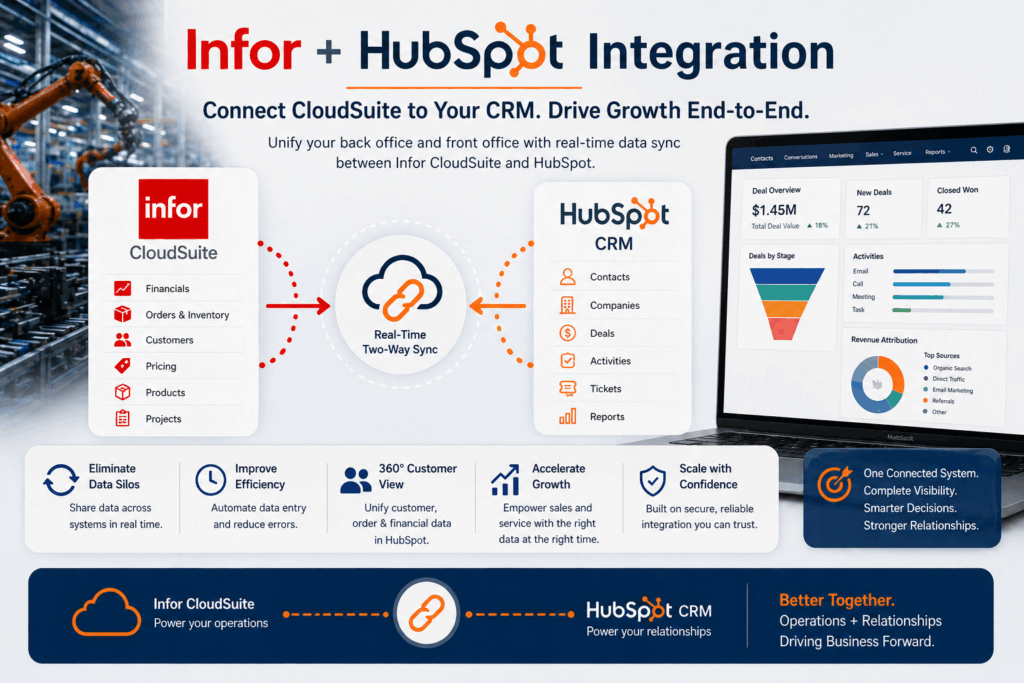
We connect the ERP systems distributors run — Epicor, SAP Business One, Infor CloudSuite, and Microsoft Business Central — with the CRMs they use: Salesforce, HubSpot, and Microsoft Dynamics 365. And we manage the entire integration lifecycle so your team doesn’t need to.
Ready to Connect Your ERP and CRM?
If your distribution business is ready to close the gap between your ERP and CRM — and give your sales and operations teams the connected data experience they need to compete — Intelligrate can help.
Contact our team today to schedule a free consultation and learn how Unity can transform your distribution operations.
About Intelligrate
Intelligrate is an iPaaS provider and integration consultancy specializing in ERP and CRM integrations for manufacturers and distributors. The Intelligrate platform connects Epicor, SAP Business One, Infor, and Microsoft Business Central with Salesforce, HubSpot, and Microsoft Dynamics 365 — fully managed, from initial setup through ongoing support. Talk with an Intelligrate Expert today.